A café can serve coffee.
A café can serve food.
But when a chef makes a café, the difference shows.
It shows in the questions asked before a dish ever reaches the table. Where did the ingredient come from? Does the flavour make sense? Is the texture right? Does the dish need something more—or perhaps something less?
It shows in the details people may never consciously notice, but somehow remember.
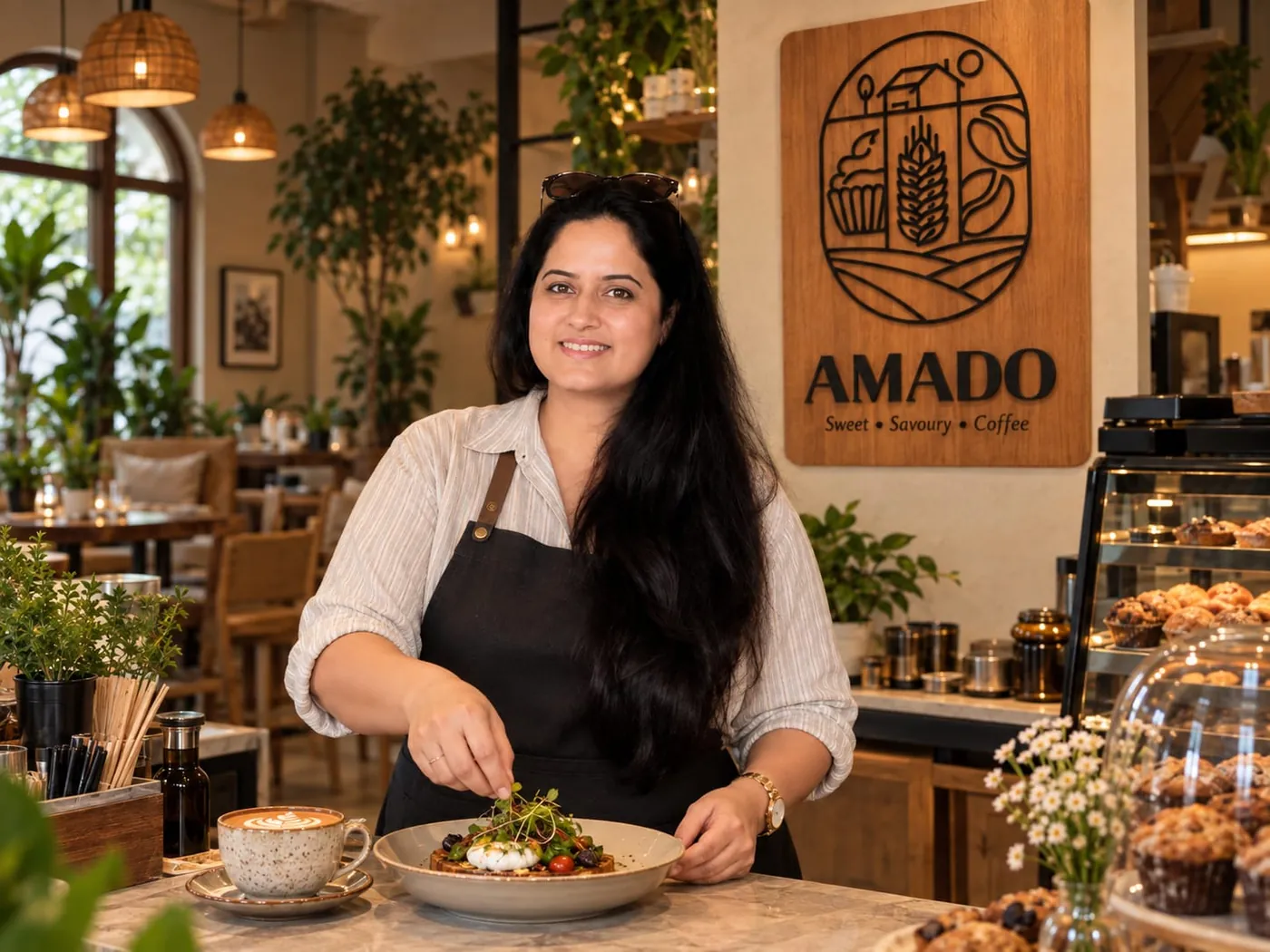
And in Bhopal, there is a café where those questions lead back to one name: Amado Café.
At the centre of Amado is Meenal Rai Shejwar, a chef and entrepreneur whose understanding of food has shaped the café into something that reaches beyond the conventional idea of a place to simply eat and drink. Amado is not presented merely as a collection of dishes. Its identity comes from the thinking behind those dishes, the ingredients that go into them, the way food is approached, and the atmosphere the café creates around the table.
That is where the story of Amado becomes interesting.
"Because when the person thinking about the food is also thinking about the place in which that food is experienced, the two begin to speak the same language."
Amado Café: More Than What Is On The Menu
The name Amado means “in love” in Latin. But the more revealing story is found not in the name itself, but in what the café has been built around.
Amado emerged as an extension of the Amado Academy of Culinary Arts, an institution that had already been closely connected with Meenal’s work in food and baking. The café therefore did not begin with an empty page. It grew from an existing relationship with cooking, teaching, ingredients and the craft of making food.
That distinction matters.
There are cafés designed around décor, cafés designed around coffee, cafés designed around a particular cuisine, and cafés designed around the social experience of meeting people. Amado brings several of these ideas together, but food remains one of its defining languages.
The café describes itself around fresh, ingredient-driven food, with a multi-cuisine menu that moves across salads, pizzas, bakery items, breakfast dishes, beverages and more. But the interesting part is not simply the range. It is the intention behind the range.
Amado's food has been associated with ingredients that are treated as something worth paying attention to. Its breads are made in-house, its menu has included produce connected to Meenal’s family farm near Sanchi, and its kitchen has explored everything from salads and eggs to sandwiches, burgers, pasta, pizzas and desserts.
That is how a café begins to become more than a menu. It becomes a place with a point of view.
Meenal Rai Shejwar: The Person Behind The Point Of View
To understand Amado, it is difficult to separate the café from Meenal Rai Shejwar.
Public profiles of Meenal describe a rather interesting movement into the culinary world. Her early professional direction was connected to finance, while cooking and baking developed into something much more central to her life. She later trained at the Academy of Pastry Arts and went on to build the Amado Baking Academy, where she has been credited with training more than 1,500 bakers.
But Amado is where that accumulated experience takes on a different form.
An academy is fundamentally about teaching. A bakery is about creating. A café adds another layer: experience.
That means Meenal’s role at Amado is not simply about deciding what food should be served. It is about creating a relationship between food and the environment around it.
That becomes particularly visible in the way the café approaches ingredients.
A chef does not necessarily look at a tomato simply as a tomato. The ingredient has origin, seasonality, texture, flavour, preparation and purpose. Bread is not simply something placed underneath a sandwich. Dough has fermentation, structure and character. Coffee is not merely a hot drink. The bean, roast, brewing method and extraction all influence what finally reaches the table.
This way of thinking changes the café. It means the menu is not just a list of things available for ordering. It becomes a collection of decisions.
At Amado, that thinking has extended even to coffee. Published accounts of the café describe Meenal travelling to Bengaluru to learn more about specialty coffee and determine the beans and brewing approach she wanted to bring to Amado.
"The chef behind a café cannot simply ask, 'Will people order this?' The more interesting question is, 'Does this belong here?' That is a very different way of building a food identity."
Beyond The Menu: Culinary Thinking Meets Operations
The title of this story could easily be reduced to a simple idea: chefs understand food better.
But that would miss what makes Amado worth examining.
The difference is not that a chef automatically creates a better café. The difference is that a chef can bring a particular way of observing food into every layer of the experience.
At Amado, that perspective can be seen through the attention given to ingredients, preparation and balance.
Take presentation. For a chef, presentation is not simply about making a plate look attractive for a photograph. It is part of the sequence through which a diner experiences food. The visual impression arrives before the first bite. Texture follows. Aroma enters. Then flavour. A dish therefore has a beginning before the fork touches it.
The same principle applies to consistency. A memorable dish served once is not enough for a café. The real test is whether the experience can be repeated. The bread needs to work again. The coffee needs to make sense again. The flavours need to hold together again.
That is where culinary thinking becomes operational thinking.
A café may have beautiful interiors, good music and comfortable seating, but if the food lacks coherence, the experience eventually breaks.
When The Difference Shows
The most revealing difference often appears in small decisions.
What deserves a place on the menu?
How many flavours should be competing on one plate?
Should an ingredient be allowed to remain recognisable, or should it be transformed?
Does a dessert need more sweetness, or does it need contrast?
Should coffee simply accompany the meal, or should it be treated as something worth exploring on its own?
These are chef's questions.
And they are precisely the kind of questions that can shape a café without appearing as a formal philosophy statement on the wall.
Amado has explored that idea through its food and beverage programme. Its menu has included house-made breads, brick-oven pizzas, salads, egg preparations, sandwiches, burgers, desserts and specialty coffee. Its events have also extended beyond ordinary dining, including coffee-focused experiences, chocolate and kombucha workshops, and food events connected with The Locavore's Millet Revival Project.
That matters because it reveals another dimension of the café. Amado is not only a place where food is consumed. It has also been used as a place where people encounter food differently.
Coffee can become something to learn about.
Millets can become a conversation about farmers, food systems and local ingredients.
Chocolate can become an experience.
A café can quietly become a meeting point between the person who makes food and the person who wants to understand it. And that is a much larger role than simply serving lunch.
The Experience People Remember
People rarely remember a café only because of its furniture.
They remember moments.
The drink that arrived at exactly the right time. The dish they did not expect to like. The dessert they ordered again. The conversation that lasted longer than planned. The place where they discovered a new ingredient. The corner where they sat for an afternoon and forgot to check the time.
This is where Amado's idea of being more than a café becomes meaningful.
The café's own story describes it as a place where food, coffee and conversations come together. That idea also appears in outside descriptions of the space, which have highlighted its natural materials, relaxed atmosphere and the sense of a place designed to feel comfortable rather than hurried.
But the atmosphere works because it has something to support it.
Food gives the room a reason to exist. And Meenal's culinary perspective gives the food a reason to be considered carefully.
That relationship is at the heart of Amado. It is why the café cannot be fully understood by looking only at photographs of its interiors or by scrolling through a menu. The more interesting question is what kind of thinking produced those things in the first place.
Amado, Beyond The Menu
There is a temptation in food writing to reduce restaurants and cafés to easy descriptions: cosy, beautiful, delicious, must-visit.
Amado deserves a more precise conversation.
Its story is really about the connection between a person who understands food and a space designed to let that understanding reach people. Meenal Rai Shejwar is central to that story because her background in baking, culinary education and food has become part of how Amado approaches its identity. The café gives that knowledge a different canvas.
An ingredient becomes a choice.
A baking technique becomes a texture.
A cup of coffee becomes an experience.
And a meal becomes something that can stay with a person after the plate has been cleared.
That may be the real meaning behind the difference.
When a chef makes a café, the chef does not simply bring recipes into a room. They bring a way of looking at food.
At Amado, that way of looking is closely tied to Meenal Rai Shejwar—and that is what makes the café's story worth reading beyond the menu. Because the most revealing part of a café is sometimes not what it serves. It is the thinking that decides why it serves it.
And at Amado, that thinking has a name: Meenal Rai Shejwar.